FOR IMMEDIATE RELEASE
February 12, 2026
MEDIA CONTACT
Elana Eden (323) 801-7996 eeden@lafla.org
Judge Rules in Favor of Unhoused Plaintiffs Whose Property Was Unlawfully Seized and Destroyed Without Due Process
FEBRUARY 12, 2026, LOS ANGELES – Late Wednesday, a federal court issued a major ruling in favor of the Plaintiffs in Garcia v. City of Los Angeles, which challenges the City of Los Angeles’s longstanding practice of seizing and destroying unhoused people’s property. In a rare move, Judge Dale S. Fisher granted plaintiffs’ motion for terminating sanctions, effectively finding liability in favor of plaintiffs on all of their claims, after finding that the City of Los Angeles had engaged in repeated misconduct over the seven-year case — including fabricating and altering key evidence.
At the heart of the case is the constitutionality of the City’s longstanding practice of seizing and destroying unhoused people’s property during encampment cleanups conducted by LA Sanitation—including property critical to keeping jobs and securing housing, such as medications, identifying documents, personal hygiene supplies, valuables, and tools required for their jobs. The City has justified this practice as necessary to address “an immediate threat to public health and safety.” The documents the City fabricated include checklists and reports the City said it used to document these hazards.
“When city workers trash our members’ belongings, they tell us it is because they are contaminated and a public health threat,” said Sherin Varghese, with Ktown for All. “But if city workers can make up evidence in a federal lawsuit, why are we supposed to believe that they aren’t lying about why they are throwing people’s belongings away in the first place?”
The City repeatedly argued that LA Sanitation workers’ use of checklists and documentation of encampment cleanups (or “sweeps”) was sufficient to protect the owners’ property rights and prevent unlawful destruction. But the Court found that the City repeatedly modified and altered these very reports. The judge found that the City acted with “willfulness, bad faith, and fault”— the “City’s misconduct has significantly undermined its credibility and the Court cannot proceed to trial with confidence that Plaintiffs have had access to true facts.” The Court found this was enough to take the rare step of issuing “terminating sanctions,” or ending the case in favor of the Plaintiffs without a trial.
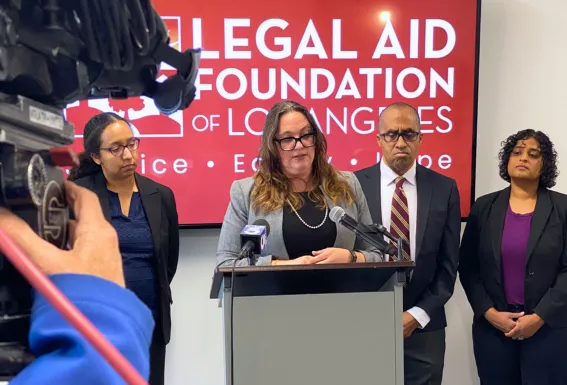
“The City’s conduct in this litigation demonstrates exactly why the due process protections Plaintiffs are fighting for in this case are so critical,” said Shayla Myers, Director of Impact Litigation and Policy at the Legal Aid Foundation of Los Angeles and lead attorney for the plaintiffs. “The City not only violated our clients’ rights when they threw away their belongings, the City and its employees violated the public trust when they fabricated evidence in a federal lawsuit, hiding the truth about what is actually happening during these sweeps.”
“Just because we’re unhoused, doesn’t mean they don’t have to respect us. This case is about making sure they treat us fairly and respect our belongings, and that they don’t do this to anyone else,” said Janet Garcia, a plaintiff in the case.
Catherine Sweetser, Director of the Human Rights Litigation Clinic at UCLA School of Law, said, “Our clients have endured years of harm, which has continued because of years of denials and dishonesty by the city. This ruling affirms that constitutional protections cannot be swept aside.”
The ruling came after almost seven years of litigation, which already resulted in a number of significant rulings in favor of the Plaintiffs. Judge Fischer previously ruled that a key provision of LAMC 56.11, the Los Angeles municipal code that allowed the City to take and immediately discard people’s belongings the City deemed “bulky,” was unconstitutional. That ruling was upheld by the Ninth Circuit Court of Appeals.
Sahng-Ah Yoo, a partner with Kirkland & Ellis LLP, said, “The court ruled that the City’s discovery abuses and defiance of court orders prolonged the case and made it impossible for our clients to get their day in court.”
“We hope this ruling marks a turning point toward more accountable, efficient, and truly effective practices to address homelessness in Los Angeles,” said Nicholas Hoffman, a partner with McGuireWoods LLP.
The Plaintiffs in the case were six unhoused residents and the community organization Ktown for All, a mutual aid organization made up of housed and unhoused residents throughout the City. They were represented by Legal Aid Foundation of Los Angeles (LAFLA), Schonbrun Seplow Harris Hoffman & Zeldes LLP (SSHHZ), UCLA School of Law’s Human Rights Litigation Clinic, Kirkland & Ellis LLP, and McGuireWoods LLP.